Commercial Furniture Trends in 2026: What's Actually Changing
Austin Frantell · 8 min read · March 17, 2026
Every year, design publications release trend roundups full of aspirational renderings and buzzwords. Most of it is noise. Here's what's actually happening in the commercial furniture industry in 2026 — the shifts that are changing how furniture gets specified, purchased, and used in real projects.
Resimercial Design Has Won
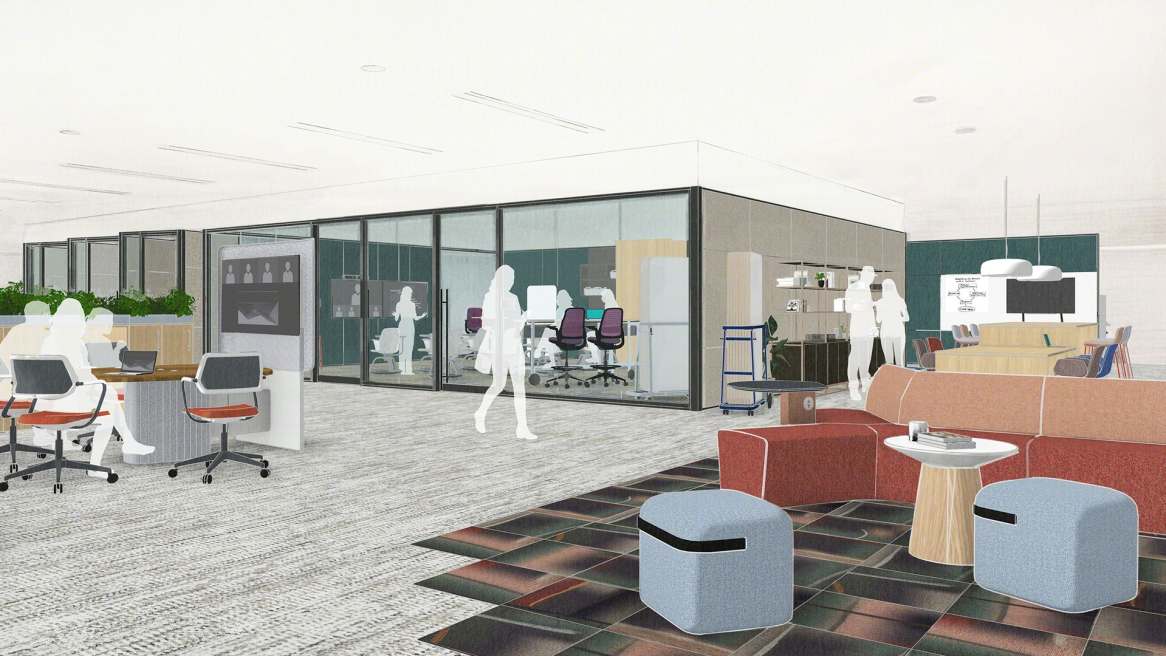
"Resimercial" — the blending of residential warmth with commercial durability — isn't a trend anymore. It's the default expectation. Walk into any recently built or renovated office and you'll see it: soft seating that looks like it belongs in a living room, warm wood finishes instead of gray laminate, area rugs defining zones instead of hard carpet tile boundaries.
What's driving it: The post-pandemic workplace has to compete with people's homes. If the office feels like an institutional environment, employees who can work remotely will choose to stay home. Companies are investing in making the office a place people genuinely want to be, and that means spaces that feel human.
What it means for buyers: Budget allocations are shifting. Lounge seating, soft furnishings, and hospitality-style finishes are taking a larger share of project budgets. Ancillary furniture — the couches, coffee tables, collaborative seating, and breakout furniture — used to be an afterthought. Now it's often 20-30% of the total furniture budget on a new project.
The challenge is finding furniture that looks residential but meets commercial durability standards. A beautiful linen sofa from a residential brand won't survive a high-traffic corporate lounge. Manufacturers like Steelcase (through their West Elm Workspace partnership), MillerKnoll (through HAY and Muuto), and dedicated ancillary brands like OFS and Arcadia have built entire lines around this intersection.
Height-Adjustable Everything
Sit-stand desks have crossed the tipping point. In 2026, the question isn't whether to include height-adjustable desks in a project — it's whether you can justify not including them.
The numbers: Most new commercial projects now specify 70-100% height-adjustable workstations. It's shifted from a perk for executives to a baseline expectation for all employees. Some markets — tech, creative, healthcare admin — are effectively at 100% adoption.
What's changed: The price premium for height-adjustable desks has dropped dramatically. A quality electric sit-stand desk used to cost $1,500-$2,000 at list. Today, capable options from major manufacturers start at $700-$900 list, and direct-to-consumer brands have pushed pricing even lower for straightforward applications.
But it's not just desks anymore. The "adjustable" expectation is expanding to conference tables (Steelcase Flex Height-Adjustable Desk), collaborative tables, and even some reception surfaces. The logic is simple: if individuals can adjust their personal workstation, why should they be stuck at a fixed-height table during a two-hour meeting?
Acoustic Solutions for Open Offices
Open offices created a problem that everyone acknowledged but few addressed adequately: noise. In 2026, acoustic management has moved from a nice-to-have to a fundamental part of workplace design.
What's available:
- Phone booths and pods — Framery, ROOM, Steelcase Work Tents, and dozens of competitors now offer prefab acoustic enclosures that don't require construction. The market has matured; early versions had ventilation and fire code issues that have been largely solved.
- Acoustic panels and baffles — Ceiling-mounted baffles, wall panels, and freestanding acoustic screens are being specified as standard finishes, not aftermarket add-ons. Brands like Kirei, FilzFelt, and even major manufacturers have acoustic product lines.
- Acoustic furniture — High-backed lounge chairs and sofas with sound-absorbing materials built in. These double as visual privacy screens and acoustic barriers, addressing two problems at once.
- Desk-mounted screens — Acoustic screens that mount to desks or benching systems, creating micro-zones of privacy without building walls.
The buyer impact: Acoustic products add cost, but they're now considered necessary infrastructure for open and hybrid offices, not optional upgrades. If you're planning an open office without an acoustic strategy, expect pushback from the employees who have to work in it.
Sustainability Requirements Are Tightening
Sustainability in commercial furniture has moved past the "nice story" phase into the "prove it" phase. Corporate ESG mandates, LEED requirements, and government procurement standards are creating real constraints on what products can be specified.
What's happening:
- Material transparency — Health Product Declarations (HPDs) and Environmental Product Declarations (EPDs) are increasingly required for major projects, not just requested. Products without this documentation are being excluded from consideration.
- Circular economy models — Manufacturers are expanding take-back and recycling programs. Steelcase's resale platform, Herman Miller's recycling program, and third-party services that manage end-of-life furniture are growing.
- GREENGUARD Gold — This indoor air quality certification has become effectively mandatory for healthcare, education, and many corporate projects. Most major commercial furniture manufacturers now certify their full product lines.
The practical effect for buyers: Pre-owned and refurbished furniture fits neatly into sustainability narratives, and procurement teams are increasingly using sustainability mandates to justify pre-owned purchasing — reusing existing furniture has a dramatically lower carbon footprint than manufacturing new product, regardless of how "green" the manufacturing process is.
AI-Driven Space Planning Is Real (But Early)
Artificial intelligence tools for workplace planning have moved from concept to functional product, though they're still in early adoption.
What exists today: Tools that analyze floor plans and automatically generate furniture layouts optimized for headcount, work styles, and building code compliance. Companies like Spaceflow, Archilogic, and features within larger platforms like Autodesk are offering AI-assisted layout generation.
What it means in practice: A space plan that used to take a designer days to develop can now be generated in minutes as a starting point. The AI handles the rules-based work — clearances, egress paths, ADA compliance — and the designer refines for aesthetics, workflow, and culture.
The honest assessment: These tools are good at generating functional layouts quickly, but they're not replacing human designers on complex projects. They're eliminating the tedious early work and letting designers focus on the creative and strategic decisions. For small businesses who might not have access to a designer, AI space planning tools may offer a genuine alternative — check if your dealer or your furniture brand offers access.
Pre-Owned Has Gone Mainstream
This is the trend with the most direct impact on buyer behavior: pre-owned commercial furniture has shed its stigma entirely.
Five years ago, buying used office furniture felt like a compromise — something you did because you couldn't afford new. In 2026, pre-owned is a legitimate first choice, driven by three converging forces:
- Sustainability mandates making reuse strategically valuable, not just cost-effective
- New furniture lead times that remain stubbornly long (8-16 weeks for custom orders)
- Quality reality — a 5-year-old Steelcase workstation is still a better product than most new budget alternatives
What's changed in the market: Pre-owned dealers have professionalized. The industry now includes companies that operate clean, organized warehouses with full product photography, documented specifications, and professional refurbishment processes. Buying pre-owned in 2026 looks nothing like rummaging through a dusty warehouse.
Authorized dealers are increasingly incorporating pre-owned inventory alongside new product, offering clients a blended approach that mixes new seating with refurbished workstations — optimizing for both budget and quality.
Flexible and Modular Over Fixed
The final trend worth noting is the continued move away from permanent, fixed installations toward modular, reconfigurable solutions.
Why: Nobody knows what their office will need in three years. Hybrid work has made headcount planning unpredictable. Companies that installed fixed panel systems in 2019 for 200 people may now need the space to support 120 in-office workers with more collaboration space and fewer individual workstations.
What this looks like:
- Freestanding benching systems replacing panel-based workstations (no bolting to walls, no hard electrical connections)
- Mobile furniture on casters — whiteboards, tables, screens, storage — that can be rearranged for different activities
- Modular lounge systems with interchangeable components (add a seat, remove a table, swap configurations)
- Lightweight, stackable seating for multipurpose spaces
The implication for buyers is clear: favor furniture that can be reconfigured, relocated, and repurposed. The fully built-out, fixed-furniture office optimized for one exact way of working is increasingly a relic. Flexibility isn't a trend — it's a risk management strategy.
The Bottom Line
The commercial furniture trends that matter in 2026 aren't about aesthetics or style — they're about function, flexibility, and accountability. Offices need to feel like places people want to be. Furniture needs to move and adapt. Sustainability needs documentation, not just talking points. And pre-owned has earned its place as a first-choice strategy, not a fallback. The buyers who understand these shifts will make better decisions and get more value from every dollar they spend.
Working on a project right now?
Share your scope and timeline — Austin and his team of specialists will review your project and follow up with tailored guidance.
Start a Project Request →Related Articles
Solving the Noise Problem: Acoustic Solutions for Open Offices
Practical acoustic treatments and furniture solutions for noisy open office environments.
7 min readIndustry KnowledgeBIFMA Certification Explained: What It Means and Why It Matters
BIFMA sets the safety and quality standards for commercial furniture. Here's what their certifications actually test and why procurement teams should care.
6 min readIndustry KnowledgeThe Dealer Markup Myth: What Furniture Dealers Actually Charge and Why
Do furniture dealers mark up prices? Yes — but not the way you think. Here's how dealer pricing actually works and why going direct isn't always cheaper.
7 min read