Office Layout Ideas for Every Budget and Team Size
Austin Frantell · 7 min read · March 17, 2026
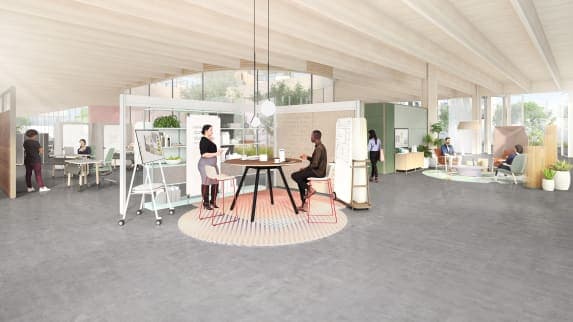
Your office layout affects everything — productivity, collaboration, morale, and your bottom line. The right layout for a 10-person startup looks nothing like the right layout for a 200-person law firm. And with hybrid work reshaping how offices are used, the old playbook no longer applies.
Here's a practical guide to the major layout types, who they work for, and what furniture they require.
Open Plan
The open plan puts everyone in a shared space with minimal or no partitions between desks. It dominated office design from roughly 2010-2020, driven by tech companies seeking to maximize collaboration and minimize cost per square foot.
Best for: Creative agencies, startups, teams under 30, collaborative work styles
Space required: 100-150 sq ft per person (the most space-efficient option)
Typical furniture: Benching systems or shared tables, task chairs, minimal storage. Budget-friendly because you skip panels, walls, and doors.
Pros:
- Lowest cost per seat — both in furniture and real estate
- Maximizes natural light penetration
- Easy to reconfigure as teams grow or shrink
- Encourages spontaneous interaction
Cons:
- Noise is the #1 complaint (see our noise level estimator)
- Visual distractions reduce focus work productivity by up to 66%
- Lack of privacy for sensitive conversations
- Employees report lower job satisfaction in fully open offices
Making it work: If you go open plan, invest in acoustic treatment, provide phone booths for calls, and create designated quiet zones. The furniture cost savings mean nothing if productivity tanks.
Private Offices
Traditional private offices with floor-to-ceiling walls and doors. Still the standard in law firms, financial services, and executive suites.
Best for: Legal, finance, executive teams, roles requiring confidentiality, deep focus work
Space required: 200-300 sq ft per person (includes office footprint plus corridors)
Typical furniture: Individual desks (often L-shaped or U-shaped), executive chairs, guest seating, personal storage, bookshelves.
Pros:
- Maximum privacy and acoustic control
- Employees have ownership of their space
- Best for focused, heads-down work
- Status signaling for client-facing roles
Cons:
- Most expensive per seat (2-3x the cost of open plan)
- Poor natural light for interior offices
- Reduces spontaneous collaboration
- Inflexible — walls can't move when teams change size
Cubicles / Panel Systems
The middle ground between open and private. Workstations divided by panels of varying heights (42" for seated privacy, 54" for standing privacy, 67"+ for full enclosure).
Best for: Government, insurance, large corporate offices, roles with moderate privacy needs
Space required: 150-200 sq ft per person
Typical furniture: Systems furniture (integrated desk, panels, overhead storage, task lighting). Brands like Steelcase, Haworth, and Herman Miller dominate this category.
Pros:
- Better noise control than open plan
- Personal space without the cost of full offices
- Integrated storage and organization
- Highly configurable panel heights and layouts
Cons:
- Can feel dated or institutional if not designed well
- Still less private than enclosed offices
- Systems furniture is expensive upfront ($1,500-4,000 per station)
- Reconfiguration requires professional installation
Activity-Based Working (ABW)
No assigned seats. Instead, the office offers a variety of settings — focus pods, collaboration zones, quiet areas, standing desks, lounge spaces — and employees choose where to work based on their current task.
Best for: Knowledge workers, hybrid teams, organizations with 50%+ daily occupancy variation
Space required: 120-170 sq ft per person (but you need fewer total seats than headcount)
Typical furniture: Mix of everything — sit-stand desks, benching, lounge seating, phone booths, high tables for collaboration, private focus pods. Plus personal lockers for belongings.
Pros:
- Optimizes space utilization (see our density calculator)
- Gives employees autonomy over their work environment
- Reduces real estate cost when combined with desk sharing
- Supports diverse work styles within one office
Cons:
- Requires cultural buy-in — people resist giving up "their" desk
- Higher furniture variety means more complex procurement
- Needs a booking system for popular spaces
- Not every role adapts well to unassigned seating
Hybrid Neighborhoods
The most popular post-pandemic approach. Teams are assigned to "neighborhoods" — zones of the office — but don't have individual assigned desks within that zone. Think of it as team-level ownership without individual desk ownership.
Best for: Companies with 3-4 in-office days, teams of 15-50, mixed collaboration and focus work
Space required: 130-180 sq ft per person
Typical furniture: Flexible workstations (easy to adjust for different users), team storage areas, bookable meeting nooks within each neighborhood, shared monitors on adjustable arms.
Pros:
- Teams sit together (preserving culture) without wasting seats on absent days
- Reduces desk count by 20-40% vs. fully assigned
- Each neighborhood can be configured for its team's work style
- Easier cultural transition than full ABW
Cons:
- Still requires a booking or check-in system
- Neighborhoods need regular rebalancing as teams resize
- Furniture must be easily adjustable (height-adjustable desks, adjustable chairs, movable monitors)
Choosing Your Layout
The right choice depends on three things:
-
What kind of work your team does. Deep focus? Go private. Constant collaboration? Go open. Mixed? Go hybrid or ABW.
-
Your occupancy pattern. If your office is 90%+ occupied daily, assigned seating works. Below 70%, you're paying for empty desks and should consider sharing.
-
Your budget. Open plan is cheapest in furniture and real estate. Private offices are most expensive. Everything else falls in between.
Use our Office Space Calculator to estimate how much space you need based on your team size and layout preference, or our Budget Estimator to see what it'll cost to furnish.
One Layout Doesn't Fit All
The best offices often combine multiple layouts. A tech company might have open benching for engineers, private offices for executives, and ABW zones for marketing. A law firm might have private offices for partners, cubicles for associates, and collaborative spaces for team work.
Think in zones, not one-size-fits-all. And remember: the furniture you choose should support the layout, not fight against it. A beautiful open plan filled with cheap chairs defeats the purpose.
Ready to plan your space? Start a project request and we'll connect you with dealers who specialize in your layout type.
Working on a project right now?
Request pricing or more information about furniture and project services. Share your scope, location, and timeline, and Austin’s team will follow up.
Request a Quote or Information →Related Articles
Open Office vs. Private Offices: The Real Trade-Offs for Commercial Buyers
Beyond the hype and backlash — a practical look at cost, productivity, acoustics, and flexibility when choosing between open and enclosed office layouts.
7 min readWorkspace PlanningSolving the Noise Problem: Acoustic Solutions for Open Offices
Practical acoustic treatments and furniture solutions for noisy open office environments.
7 min readWorkspace PlanningRemote vs. Hybrid vs. In-Office: Furniture Needs for Every Work Model
How your work model changes your furniture requirements — from hot-desking setups for hybrid teams to home office stipends for remote workers.
7 min read