Disassembly
Workstations, panel systems, and modular furniture are carefully disassembled by crews who know how to take them apart without damage. All hardware is labeled and bagged.
Moving commercial furniture requires more than a truck and some blankets. Professional moving crews specialize in disassembly, protection, transport, and reassembly of office workstations, panel systems, and everything in between.
Plan your inventory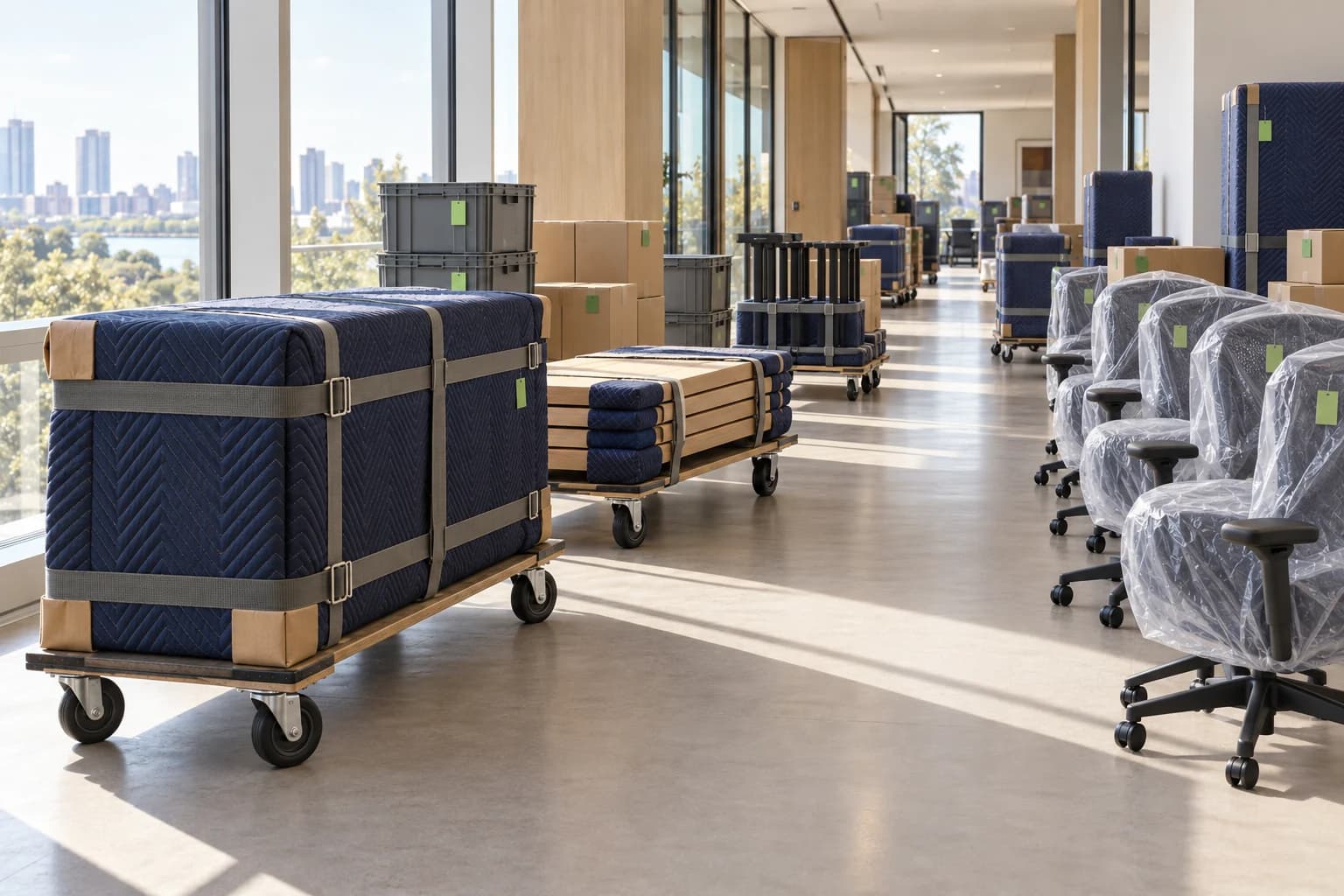
End-to-end service from the old space to the new one. Professional movers handle every step so your team can focus on business.
Workstations, panel systems, and modular furniture are carefully disassembled by crews who know how to take them apart without damage. All hardware is labeled and bagged.
Every piece is wrapped in moving blankets, shrink wrap, or custom protection. Glass, veneer, and high-value items receive extra padding and corner protection.
Furniture is loaded onto air-ride trucks by experienced crews. Climate-controlled options available for sensitive materials. GPS tracking on all shipments.
At the destination, furniture is reassembled per your floor plan, leveled, cleaned, and tested. Power and data connections are restored.
All packing materials are removed from both the origin and destination. Both spaces are left clean and ready.
Every move is different. Here are the factors that influence your quote.
Dock availability, elevator reservations, COI requirements, and after-hours access all affect scheduling and cost.
High-rise buildings with limited elevator access or walk-up buildings add time and labor.
Panel systems and workstations require more labor than freestanding desks and chairs.
Local moves (same metro) vs. long-distance (cross-state or cross-country) have different logistics and pricing.
Weekend and after-hours moves cost more but minimize business disruption. Rush moves require additional crews.
Glass conference tables, art, AV equipment, and server racks require specialized handling and insurance.
The moving team visits both locations to assess access, furniture inventory, and logistics.
You receive a detailed quote with crew size, timeline, and cost breakdown.
Crews disassemble, wrap, and protect all furniture at the origin site.
Furniture is loaded, transported, and delivered to the new location.
Everything is reassembled, placed per your floor plan, and verified in a walkthrough.
A successful commercial furniture move starts weeks before the first truck arrives. Inventory and asset tagging is the foundation that prevents items from being lost, misplaced, or delivered to the wrong location. Here is how professional moving companies approach this phase.
Every piece of furniture gets cataloged: product type, manufacturer, model (if identifiable), condition, and current location. For large moves (100+ stations), professional moving companies use move management software — tools like MoveManager, MoversSuite, or CMS (Computerized Maintenance Systems) — to create a digital inventory tied to floor plans. Each item receives a unique identifier that links it to its destination on the new floor plan. This inventory serves triple duty: it guides the move crew, provides a checklist for verification at the destination, and creates a record for insurance claims if damage occurs.
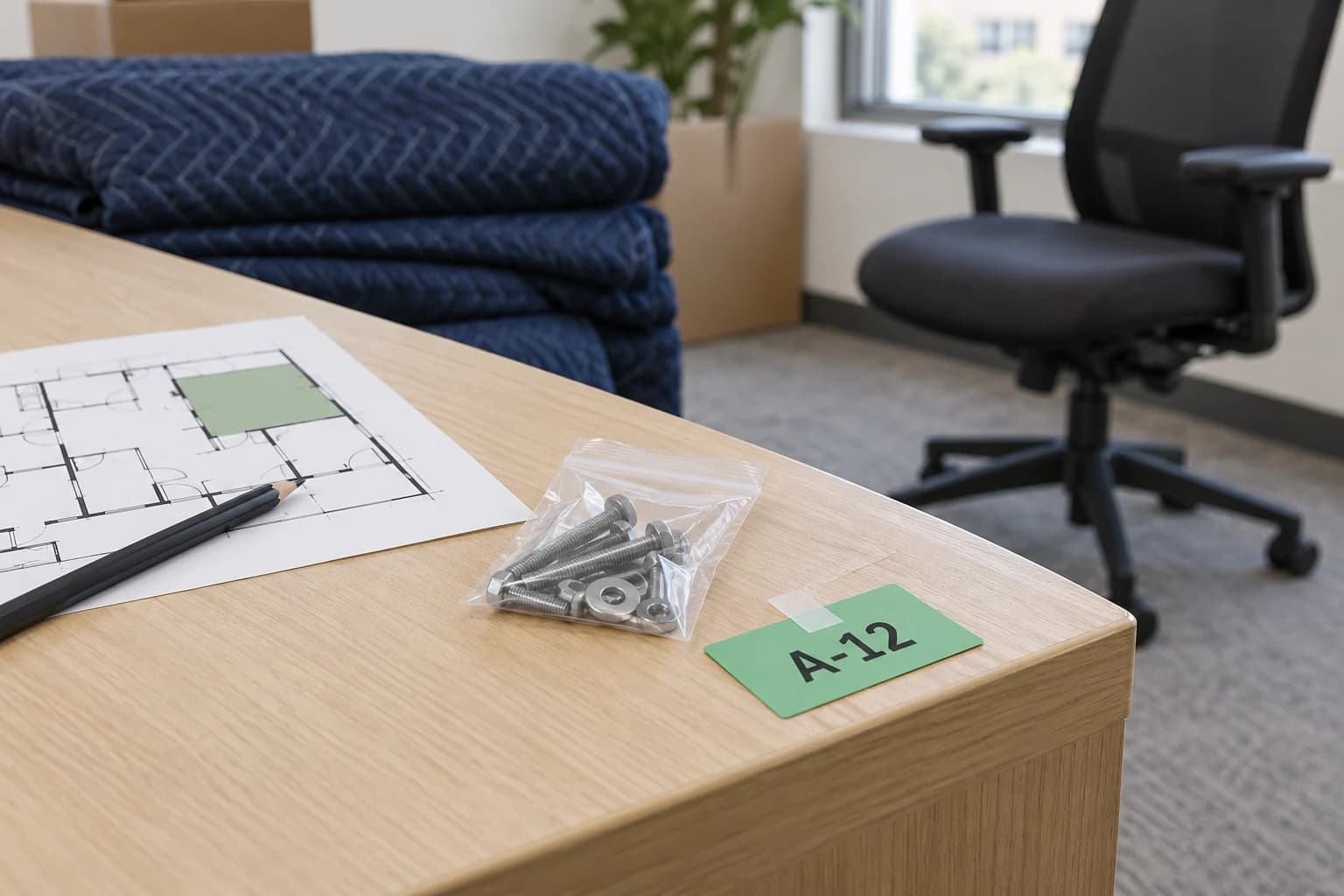
The industry standard for office moves is a color-coded dot and label system. Each department, floor, or zone gets a unique color. Every piece of furniture in that zone gets a matching colored label with its destination room or station number. The destination floor plan is also color-coded to match. This allows move crews — who may not know department names or employee names — to deliver items to the correct zone based on color alone, then place them precisely using the station number. Most professional movers use pre-printed label systems from suppliers like Smead, SteelMaster, or custom-printed rolls.
Every item that moves gets a label — not just desks and chairs, but monitors, personal file pedestals, keyboard trays, desk lamps, whiteboard easels, and personal crates (provided to employees to pack personal items). Items staying behind or going to surplus should be tagged differently (typically red) to prevent accidental relocation. Items being decommissioned or sent to liquidation get a third designation. A thorough tagging process takes 1-2 days for a 100-person office.
See how a room code connects an item, its components and its place on the new plan.
Match the station number to the approved plan. Keep hardware with its furniture.
Example label system. Use your project's own room and station numbers.
Commercial furniture includes a wide range of materials, each with different vulnerability profiles. Professional movers use material-specific protection — not a one-size-fits-all approach. Here is what proper protection looks like by material type.
Veneer surfaces (conference tables, executive desks, credenzas) are the most damage-prone items in any move. A single scratch through the finish layer exposes the substrate and requires professional refinishing ($200-800 per piece). Veneer pieces should be wrapped in moving blankets (minimum 72"x80" quilted pads), then covered in shrink wrap to keep the blankets in place. Corrugated cardboard corner protectors should be applied to all edges. Veneer items should never be stacked face-to-face without blanket padding between them.
Glass conference table tops, glass whiteboards, and glass office fronts require custom crating or A-frame dollies designed for flat glass transport. Standard moving blankets are not sufficient — glass needs edge protection with foam rails and surface protection with blanket padding on both faces. Tempered glass (the standard for commercial furniture) is strong against impact but shatters completely when it does fail. Glass tops should be transported vertically on an A-frame cart, never laid flat and stacked. Professional movers use suction cup lifters rated for the specific glass weight.
Fabric-covered chairs, lounge pieces, and panel system fabrics are vulnerable to soiling, tearing, and moisture. Chairs should be wrapped in stretch film or chair covers (available in standard sizes from moving supply companies). Lounge pieces — sofas, club chairs — need full blanket wrapping with stretch film overlay. Panel fabrics should never be placed face-down on dirty floors or truck beds. During transport in wet conditions, moisture barriers (plastic sheeting) should cover all upholstered items. Stains set into commercial fabric during a move are often permanent.
Monitors, docking stations, video conferencing equipment (Poly, Crestron, Logitech systems), and AV racks require anti-static packaging and shock protection. Original manufacturer boxes are ideal but rarely available. Professional movers use custom foam inserts or anti-static bubble wrap. Hard drives and servers should be transported in climate-controlled, air-ride vehicles. All cable connections should be photographed before disconnection and labeled for reconnection at the destination.
Professional moving companies conduct route surveys at both the origin and destination to identify potential obstacles before move day. This step is especially critical for multi-floor moves in high-rise buildings.
In buildings with 10+ floors, the freight elevator becomes the primary bottleneck. A single freight elevator with a 60-second cycle time (load, travel, unload) can move approximately 40-50 loads per hour. For a 200-person office move, that translates to 8-12 hours of elevator time just for furniture — not including personal crates, IT equipment, and common area items. Professional movers calculate elevator throughput as part of the proposal and schedule move waves accordingly. Some large moves require exclusive elevator access for 2-3 consecutive days.
Professional movers plan truck loads in reverse delivery order — the first items needed at the destination are loaded last. For multi-stop moves, each stop's furniture is grouped together. Standard moving trucks for commercial furniture are 26-foot box trucks or 53-foot semi-trailers. A 53-foot trailer holds approximately 50-75 workstations (disassembled) or 200-300 stacking chairs. Air-ride suspension (standard on professional moving trucks) reduces vibration damage during transport. For long-distance moves exceeding 500 miles, dedicated trucks (not shared loads) are strongly recommended to minimize handling.
Understanding insurance coverage before a move starts is critical. Damage discovered after the crew leaves is exponentially harder to resolve than damage documented in real time.
Professional moving companies should carry: general liability insurance ($1-2M), cargo/transit insurance (covering furniture value during transport), workers' compensation, and auto liability. The cargo insurance is the critical one — it covers damage to furniture while in the mover's care, custody, and control. Standard coverage is typically $0.60 per pound per article (basic carrier liability) or full replacement value coverage at an additional premium of $5-15 per $1,000 of declared value. Always opt for full replacement value coverage, especially for premium brands.
All damage must be documented at the time of delivery — not days later. The industry standard process: the move supervisor and client representative walk through together, inspecting every piece as it is placed. Damage is photographed (close-up of the damage, wide shot showing the item and its label), recorded on a damage report form with the item's inventory tag number, and signed by both parties. Claims filed more than 72 hours after delivery are routinely denied. For high-value items (executive furniture, art, specialty pieces), conduct a pre-move condition report with timestamped photos at the origin site.
Move timelines depend on volume, distance, building complexity, and the amount of disassembly/reassembly required. Here are realistic benchmarks.
Most commercial moves are scheduled for evenings and weekends to minimize business disruption. Friday evening through Sunday afternoon is the most common window. After-hours and weekend moves typically cost 15-30% more than standard business-hour moves.
Without an inventory and labeling system, items end up on the wrong floor, in the wrong office, or missing entirely. Recreating a 100-person office layout from memory after a chaotic move is a multi-day disaster. Invest in proper tagging — it adds 1-2 days upfront but saves a week of corrections.
Panel-based workstations (Steelcase Answer, Haworth Compose, Herman Miller Canvas) take 30-60 minutes each to disassemble properly. A 50-station floor requires 25-50 labor hours just for disassembly — plus the same for reassembly at the destination. Proposals that do not account for systems furniture complexity will run over budget and over time.
Both the origin building and destination building need dock reservations, freight elevator access, COI submissions, and after-hours security coordination. Missing any one of these at either location can delay the move by days. Submit building access requests at least 2-3 weeks in advance.
Moving furniture that should be decommissioned costs real money — disassembly, wrapping, transport, and reassembly labor for a piece that will end up in storage or disposal. Before the move, audit the inventory and tag items as keep, liquidate, donate, or dispose. Moving costs $3-8 per item; making that decision before the move is free.
Without pre-move condition documentation, it is impossible to prove that damage occurred during transit rather than before. Photograph all veneer surfaces, glass tops, and executive furniture before disassembly. Include a timestamp in the metadata or hold a dated card in the frame.
Budget moving companies often carry minimal cargo insurance — $0.60 per pound, which values a $1,200 Steelcase Leap chair at roughly $30. Full replacement value coverage costs more but provides actual protection. Verify coverage limits and deductibles in writing before signing the contract.
Describe your move and get connected with professional crews who can provide a detailed proposal — crew size, timeline, logistics, and cost.
Furniture images are illustrative AI-generated scenes.